The Imaging Research Center (IRC) is happy to announce the four winners of the 2026 IRC Faculty Research Fellowship winners. The winners for the two calls are:
IRC Faculty Research Fellows 2026 General Call
Sust(A.I.)nable Entanglements: Collaboratively Creating with Bio-Digital Hybrid Intelligences
Eric Millikin, Department of Visual Arts
Fiona Bell, Department of Information Systems
Project Summary:
In the past decade, we have seen rising interest in both AI and BioArt. While these two fields are seemingly at odds, AI highlights a shift towards a rapidly digital world, while BioArt demonstrates a shift towards reconnection with the biological world. However, they both provide new avenues for creatively collaborating with intelligences that are not entirely human, or rather, more-than-human. Accordingly, we propose exploring this intersection between digital and biological by developing a new AI-driven system for creating biomaterial-based sculptural objects that embody these bio-digital hybrid intelligences. We envision developing 3D models in the IRC using photogrammetry scans of biological matter, machines, and humans, which will be fed into a custom AI model to generate new hybrid forms that will be fabricated using techniques like 3D printing, laser cutting, casting and molding. These processes will use experimental bioplastics and bioceramics made from model-relevant matter, including wearables to wall hangings to free-standing sculptures. These sculptural objects will embody new ways for collaboratively creating with AI and biological materials, as well as offer deeper reflections on the ethical tensions that emerge regarding agency, materiality, and sustainability. These findings will be disseminated through a touring exhibition, submissions to relevant human-computer interaction and media art publications, and educational talks, workshops and future funding opportunities.
PI Bios:
Fiona Bell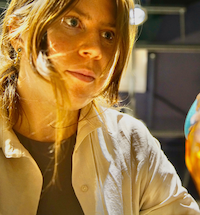
Fiona Bell is a biodesigner, creative technologist, and Assistant Professor of Human-Centered Computing at the University of Maryland, Baltimore County, where she directs the Entangled Ecologies Lab. Her research focuses on the intersection of biological materials with digital technologies to develop bio-digital artifacts for regenerative futures. At the IRC, she plans to explore how to collaboratively create across artificial and biological intelligences by designing a collection of AI-generated and digitally fabricated sculptural objects made from site-specific biomaterials. Through this work, she plans to ask how bio-digital hybrids can support sustainable planetary flourishing.
Eric Millikin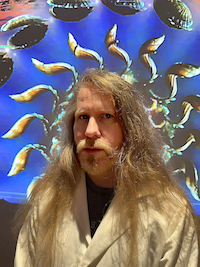
Eric Millikin uses biotech, robotics, and other emerging media as strategies for societal transformation. In three years as Assistant Professor of Visual Arts at the University of Maryland, Baltimore County, he has had numerous performances, and screenings around the world, from Algeria, Argentina and Australia to Tokyo, Tanzania and Turkey. His most recent projects include performances at The Voxel in Baltimore and at Yale University. His current projects include synthetic biology artwork with MIT’s Media Lab and the Baltimore Underground Science Space. At the IRC, he will collaboratively investigate new and more ethical ways biology and technology may grow together.
IRC Faculty Research Fellows 2026 The AI State
Mapping bias in and through AI Rhetorics
Jennifer Maher, Department of English
Rebecca Williams, Department of Computer Science and Electrical Engineering
Project Summary:
This project asks a central, generative question: If redlining was produced by a system that claimed to be rational and neutral, what happens when we let today’s “rational” systems imagine space instead? Redlining was not harmful because it used maps, data, or classification. It was harmful because it treated one way of reasoning about space as authoritative and unquestionable. Contemporary AI systems risk reproducing this same logic if their rhetorical power is left uninterrogated, especially AI that is used to classify, optimize, and partition communities and their space. This project develops an AI-mediated countermapping environment focused on Baltimore City that uses speculative, counterfactual mapmaking to examine how spatial authority is constructed, stabilized, and challenged. Rather than asking which spatial boundaries are correct, the project investigates how arguments about space come to seem reasonable, inevitable, or dismissible. AI is used not as a solution engine, but as a rhetorical medium: a system that sounds and behaves like authority, allowing us to vary premises while holding procedural form constant, using rhetoric as a form of inquiry into how knowledge is made spatially credible.
PI Bios:
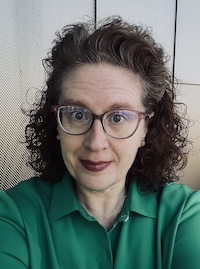 Jennifer Maher
Jennifer Maher is Chair of the Department of English and an Associate Professor. Her research and teaching interests include rhetorics of technology, technical communication, and the city of Baltimore. And her current book project explores why rhetoric matters, especially in the age of AI. At the IRC, she will explore how bias in AI systems generate real-world inequities but also offer new methods to expose and correct these inequities. More specifically, she will collaboratively develop an AI-mediated counter-mapping environment focused on Baltimore. Through speculative, counterfactual mapmaking, she aims to help users examine 1. how spatial authority is constructed, stabilized, and challenged, and 2. how AI systems function rhetorically.
Rebecca Williams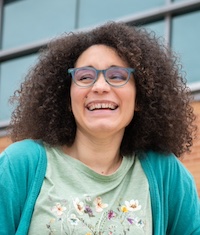
Rebecca Williams is an Assistant Professor in the Computer Science Department, where her research focuses on computing/AI education, visualization, and technology ethics in the MISFIT Lab. Our project will develop an AI-mediated countermapping environment focused on Baltimore City, using speculative and counterfactual mapmaking to investigate how spatial authority is constructed, stabilized, and challenged, allowing users to vary premises and examine how certain arguments about space come to seem inevitable, reasonable, or dismissible.