FOR 40 YEARS
The IRC is celebrating our founding vision where the future of computers will one day be ubiquitous and their creative power will be in the hands of everyone. Today more than ever, the IRC brings together students, faculty, and researchers across disciplines to collaborate on projects spanning industry, scholarship, and the creative fields.
To celebrate we will have a series of public events, exhibitions, and panels in Spring 2027 focusing on historical projects that expand the definition of media at the IRC, UMBC and the world.
EXHIBITION
Alison Knowles: The House of Dust
January 26 – May 23, 2027
AOK Library Gallery
Performance and exhibit Reception – March 4, 6:00 p.m.
Public Programming dates [TBA]
Alison Knowles: The House of Dust will advance our understanding of a post-war artist whose work has been shaped by her innovations in chance, systems, participation, language, and social practice. The exhibition will present The House of Dust, the groundbreaking computerized poem Knowles developed with James Tenney at Bell Labs in 1967, as a live, open-ended printing of its inherently generative permutations on green and white paper.
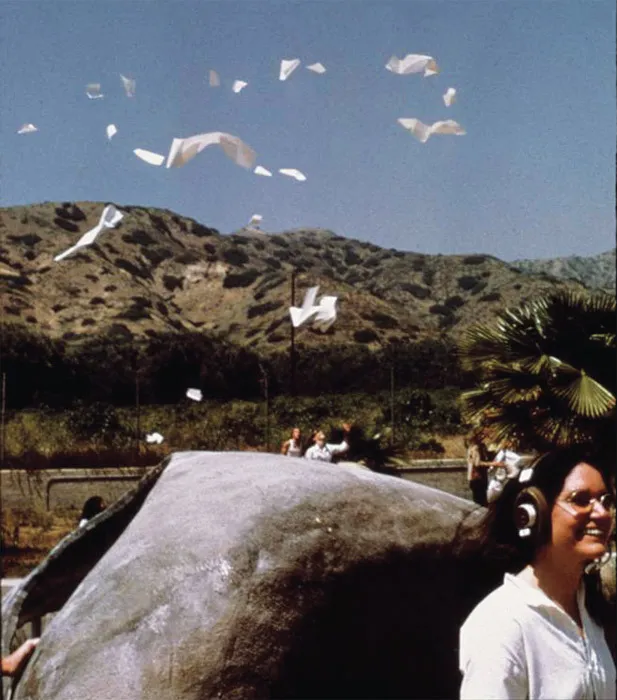
The poem was subsequently realized as a social sculpture in Burbank, California, in 1971. A historically accurate, life-size augmented reality [AR] reconstruction of the Burbank House of Dust, [approximately 15x18x5′]. Gallery visitors will be offered AR glasses and an opportunity to experience the social sculpture, to scale, as it was in 1971. The completed virtual The House of Dust social sculpture will be permanently archived in the AOK Gallery and Archive as a resource for scholars, artists, curators, and students.
For 25 years, the Albin O. Kuhn Gallery & Archive has been home to the Dick Higgins Collection at UMBC. The project is curated by Lisa Moren, Director of the Imaging Research Center (IRC), Professor of Visual Art who acquired the original Higgins Collection. For decades, the Collection has worked to preserve and disseminate this history through exhibitions, publications, performances, teaching, and research. The Collection includes over a thousand prints, folios, books, Fluxkits, audio recordings, “unnamables,” and other materials documenting the artistic practice of Alison Knowles.
The exhibition will include rarely displayed archival materials from the Dick Higgins Collection, works from the Knowles estate, including prints, silkscreens, photographs, and related objects. Public programs will include a panel of scholars and artists to examine Knowles’s work and the significance of The House of Dust, and will be recorded and livestreamed through UMBC. The exhibition, a live display of the early computerized poem, an AR reconstruction of the poem’s social sculpture, and scholarly programming will assert UMBC’s historical commitment to an important contribution of postwar American art that influences an expanded definition of media to this day.
EARLY COMPUTER TIMELINE
Mary Ellen Bute & Ben Francis Laposky: Abstronics and Oscillons
1951–1952
Filmmaker/animator Mary Ellen Bute created “Abstronics” as prints and a film using cathode-ray oscilloscopes to generate abstract motion art. Concurrently, artist Ben Francis Laposky manipulated electrical beams on an oscilloscope to produce gelatin silver photographs he called “Oscillons,” among the earliest visual artworks produced electronically.


Desmond Paul Henry: Mechanical Drawing Machines
1960
Desmond Paul Henry modified World War II analogue bombsight computers to construct mechanical drawing machines capable of producing complex, recurring geometric graphics. His automated, machine-generated abstract line drawings were among the earliest physical computer graphics exhibited in the UK.
James Tenney: Computer Music at Bell Labs
1961
Composer James Tenney began a residency at Bell Labs, utilizing FORTRAN programming and punch cards to compose computer-generated music. Working alongside Max Mathews, Tenney developed landmark algorithmic compositions such as Analog #1 (Noise Study), pioneering computer audio synthesis.


Early Plotter Art Innovations
1962
Early computer artists began utilizing mechanical vector plotters—such as CalComp plotters—to translate digital code and algorithmic equations into physical ink-on-paper drawings. These plotters became the primary physical output medium for early digital artists, establishing line-based generative computer art.
Douglas Engelbart: Augmenting Human Intellect
1962
Douglas Engelbart publishes “Augmenting Human Intellect: A Conceptual Framework” inspired by Vanaveer Bush’s landmark essay “As We May Think” (1948), iteratively describing where computer processing more closely mimics human thought processes than written language and is therefore a valuable new research aid.


Ken Knowlton: Pixellated Graphics & Pixim
1964
Ken Knowlton developed the TARPS and Pixim programming languages at Bell Labs, enabling the creation of bitmap computer animations and raster graphics. He famously collaborated with artists to generate giant pixellated portrait collages using computer symbols and alphanumeric characters.
Jonas Mekas Curates Expanded Cinema Festival
1965
Jonas Mekas coined the term “Expanded Cinema” while curating a landmark festival showcasing multi-projection and experimental visual media. The festival featured works by Stan VanDerBeek alongside Andy Warhol, Claes Oldenburg, Nam June Paik, and other avant-garde figures pushing beyond traditional screen boundaries.


Ted Nelson Coins Hypertext & Hypermedia
1965
Ted Nelson coins the term “hypertext” and “hypermedia” in an academic paper presented at an Association for Computing Machinery (ACM) national conference. Hypertext is later adapted in 1989 by Tim Berners-Lee to describe his HTML code to display internet content in by 1993.
Dick Higgins Publishes Intermedia Essay
February 1966
Dick Higgins published his landmark essay “Intermedia” in the Something Else Press Newsletter, coining the term to describe art forms that blur boundaries between traditional disciplines. The concept became a cornerstone for computer, performance, and multi-media art movements of the era.


Stan VanDerBeek Debut of Movie-Drome
1966
Stan VanDerBeek debuted “Movie-Drome” a 31-foot-diameter, an immersive environment employing 16mm film projectors, slide projectors, overhead projectors, spotlights, a quadraphonic sound system, bringing together newsreels, found film, and VanDerBeek’s own animations, along with drawings and art historical, anthropological, commercial, and popular images, to create a disjunctive, overlapping, and ever-transforming field of information. This launched a movement in “Expanding Cinema.”
9 Evenings: Theatre and Engineering
October 13–23, 1966
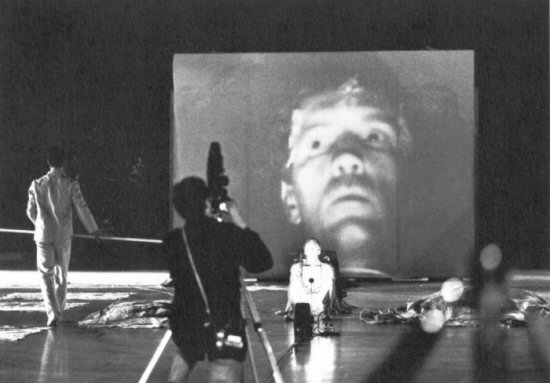
Organized by artist Robert Rauschenberg and engineer Billy Klüver presented “9 Evenings: Theatre and Engineering at the 69th Regiment Armory in New York City. In addition to Rauschenberg, performances by artists included John Cage, David Tudor, Merce Cunningham, Yvonne Rainer, Lucinda Childs and many others who created a variety of experimental methods with hardware, sensors, wireless triggers, audio, infra-red cameras and projection, in collaboration with Bell Labs engineers. This was attended by many artists in NYC including Alison Knowles, and Stan VanDerBeek, who filmed the events and rehearsals.

Launch of Experimental Art and Technology (E.A.T.)
November 1966
Following 9 Evenings, Billy Klüver, Robert Rauschenberg, Fred Waldhauer, and Robert Whitman officially established Experiments in Art and Technology (E.A.T.). The organization was founded to foster systematic, ongoing collaborations between fine artists and industrial engineers/scientists.
Alison Knowles: The House of Dust
1967–1969
Fluxus artist Alison Knowles created The House of Dust in collaboration with James Tenney, one of the earliest computer-generated poem structures written in FORTRAN. Published as a book in 1969 by Walther and Kasper König, the algorithmic quatrains were later translated into a physical fiberglass architectural structure in California.


Museum Exhibitions for E.A.T.
1968
E.A.T. expanded its institutional reach with major exhibitions at the Museum of Modern Art (The Machine as Seen at the End of the Mechanical Age) and the Brooklyn Museum (Some More Beginnings). These shows brought computer-aided art, cybernetics, and collaborative engineering installations to mainstream museum audiences.
Harold Cohen: Beginnings of AARON
1968
Artist Harold Cohen began exploring computing after relocating to the US, eventually leading to his creation of AARON, an artificial intelligence program designed to autonomously generate art. His work marked a major shift toward algorithmic autonomy and artificial intelligence in visual arts.


Lillian Schwartz: Computer Animation at Bell Labs
1968
Lillian Schwartz began her pioneering residency at Bell Labs, working alongside computer scientists to produce early digital animations and computer-generated films. Her art explored visual perception, color theory, and digital image processing, establishing her as a key innovator in digital media.
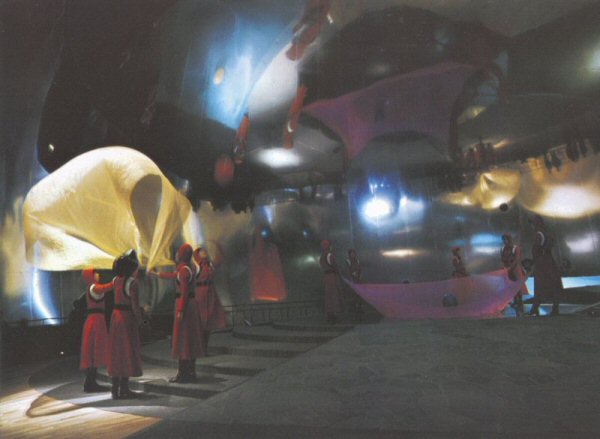
E.A.T. Pepsi Pavilion at Expo ’70, Osaka
1970
E.A.T. designed the iconic Pepsi Pavilion for Expo ’70 in Osaka, Japan, featuring a fog sculpture exterior and an immersive interior environment. Artists Stan VanDerBeek, Robert Whitman, and Lillian Schwartz screened custom films inside the 90-foot spherical Mirror Dome auditorium.